

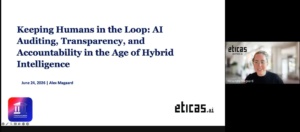
On 24 June 2026, TWIN4DEM organised an online stakeholder workshop titled “Keeping Humans in the Loop: AI Auditing, Transparency and Accountability in the Age of Hybrid Intelligence.” delivered by project partner Eticas. The workshop was organised in collaboration with Fondazione Bruno Kessler (FBK) and was addressed to the doctoral candidates of the HYBRIDS Marie Skłodowska-Curie Doctoral Network. The session explored how AI auditing can help ensure that AI systems remain transparent, accountable and aligned with democratic values while keeping humans at the centre of AI-enabled decision-making.
The workshop was presented by Alex Magaard, Head of Policy at Eticas, who introduced participants to the principles and practical applications of AI auditing. Drawing on Eticas’ expertise in evaluating AI systems, the session demonstrated how structured auditing methodologies can improve the reliability, fairness and transparency of AI tools throughout their lifecycle.
A key focus of the workshop was understanding where and when AI systems should be audited. Participants explored the different stages of AI development, from data collection and model training to deployment and post-deployment monitoring, highlighting the responsibilities of both AI developers and researchers using AI systems. The discussion emphasised that meaningful auditing begins with understanding how an AI system is built and how humans interact with it.
To support this process, Eticas introduced a six-component socio-technical system mapping framework, covering the data, model, outputs, human-AI interaction, societal impact, and monitoring mechanisms of AI systems. This approach enables researchers to identify potential risks before they become operational issues while ensuring that human oversight remains embedded throughout the system.
The workshop also demonstrated how system mapping can be translated into practical risk identification. Participants examined a comprehensive AI risk taxonomy addressing governance, bias and fairness, privacy, reliability, security, misuse and environmental sustainability. For each category, the session presented strategies for detecting and mitigating risks during the pre-processing, in-processing and post-processing phases of an AI system’s lifecycle.
To illustrate these concepts in practice, Eticas presented two case studies. The first examined a hate speech classifier, showing how technical and socio-technical system mapping can reveal risks related to transparency, appeals mechanisms and bias. The second focused on the TWIN4DEM Digital Twin, demonstrating how auditing methodologies are being adapted to evaluate an agent-based simulation designed to support research on executive aggrandisement and democratic resilience.
The Digital Twin example highlighted several important considerations, including documenting system limitations through model cards, improving transparency for end users, supporting consistent scenario construction, and identifying structural assumptions that may influence simulation outcomes. These examples illustrated that auditing is not only about identifying failures, but also about strengthening confidence in AI systems by clearly communicating both their capabilities and limitations.
The workshop concluded with an interactive discussion on how researchers, policymakers and technology developers can work together to ensure AI systems remain accountable, transparent and centred on human oversight. By bringing together technical expertise and stakeholder perspectives, the event contributed to TWIN4DEM’s broader mission of developing trustworthy AI tools that support democratic governance.
As the project progresses, TWIN4DEM will continue organising stakeholder engagement activities to foster dialogue, share project developments and promote responsible AI practices across research and policymaking communities.