

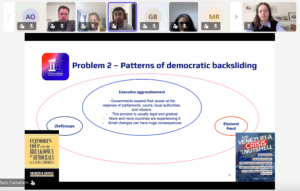
In March, the TWIN4DEM project continued its participatory work through a new round of online focus groups in Hungary, Czechia, France and the Netherlands. The sessions brought together a diverse group of stakeholders, including policymakers, civil society representatives, journalists, and researchers, ensuring a wide range of perspectives.
These discussions marked an important milestone in the project’s development. Participants were invited to explore the first version of the TWIN4DEM “toy model”, an early-stage digital twin designed to simulate pathways of executive aggrandizement. This initial exposure allowed stakeholders to engage directly with the concept and provide feedback on its structure, functionality, and potential applications.
The discussions generated valuable insights into how the model can be made both meaningful and usable for its intended audiences. A recurring point raised by participants was the importance of transparency: for the model to gain trust and be widely adopted, it must clearly communicate not only its outputs and scenario variations, but also the underlying mechanisms that generate them.
In parallel, participants highlighted key ethical and governance considerations. Ensuring full compliance with data protection standards, including GDPR, was identified as a fundamental requirement. Particular attention was given to decisions around data storage and infrastructure, as well as the need to provide clear, accessible explanations of how user data is collected, processed, and managed—especially in cases where external services are integrated.
To further strengthen this co-creation process, two additional online focus group discussions are scheduled for 29 April and 11 May. These sessions will aim to gather further input, with a specific focus on increasing participation from Hungary and Czechia, in order to ensure stronger contextual representation and more locally grounded insights.
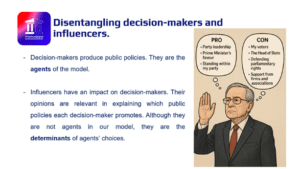
The feedback collected throughout these activities will directly inform the next phase of the project. The TWIN4DEM team will continue refining the model, expanding its data foundations, and preparing it for further testing and validation. Ongoing stakeholder engagement remains central to this process, ensuring that the digital twin evolves as a robust, transparent, and policy-relevant tool aligned with real-world democratic needs.